Charting Blackjack Decision Trees: Mapping Optimal Play Paths Through Probability Matrices in Digital Formats
Written by Alex Richter · Jul 20, 2026
Charting Blackjack Decision Trees: Mapping Optimal Play Paths Through Probability Matrices in Digital Formats
Blackjack decision trees map every possible hand combination against dealer upcards through structured branches that represent hit, stand, double, or split choices, and these structures rely on probability matrices to assign values to each outcome based on remaining deck composition. Researchers have long calculated these matrices using combinatorial analysis that factors in card removal effects, while digital formats now allow real-time updates to those matrices during play sessions.
Foundations of Decision Trees in Blackjack Strategy
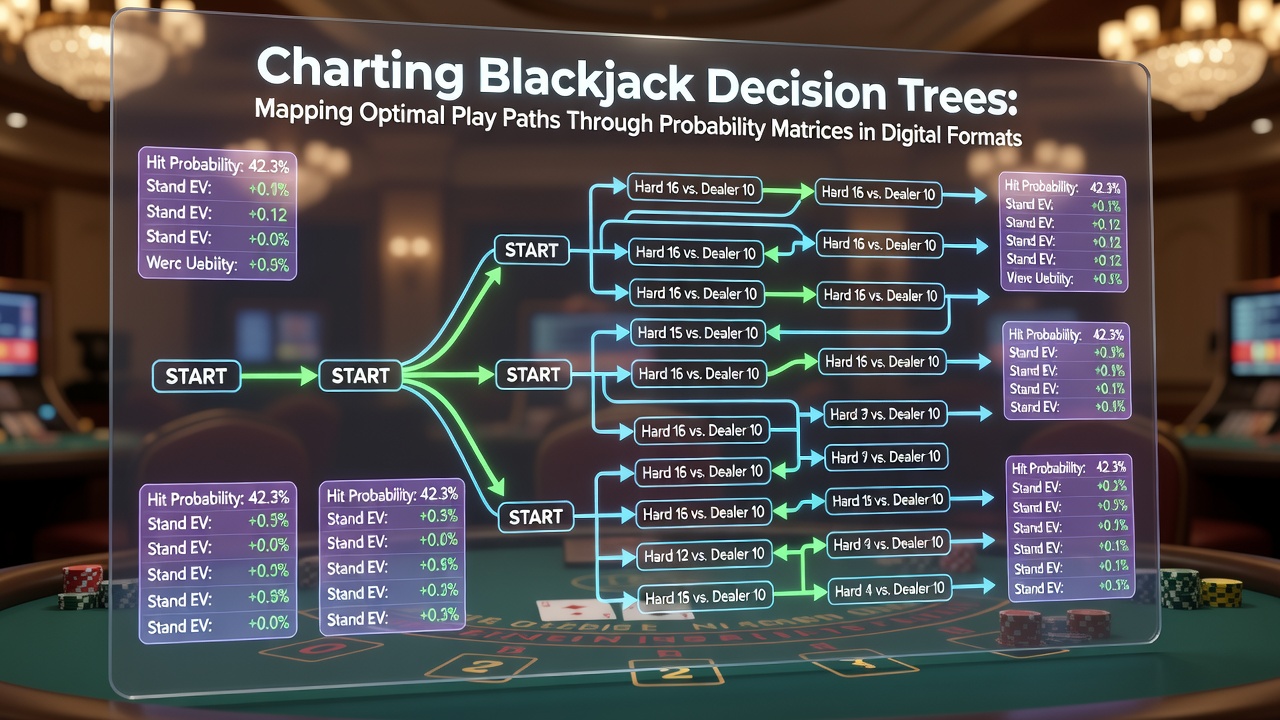
Decision trees begin with root nodes that represent initial two-card player hands paired against a visible dealer card, and branches extend outward for every subsequent action while terminating at leaf nodes that show expected values derived from complete probability distributions. Studies from institutions such as the University of Nevada Las Vegas demonstrate how these trees reduce house edges when players follow paths that align with matrix-calculated thresholds rather than intuition alone. Observers note that trees grow exponentially with multi-deck shoes yet remain manageable because many branches share identical substructures that software can cache for efficiency.
Building and Refining Probability Matrices
Probability matrices store the likelihood of every possible dealer final hand given a specific upcard along with the distribution of player totals after each draw, and these grids update dynamically when cards leave the shoe. Data compiled by the Australian Gambling Research Centre shows that single-deck matrices differ measurably from eight-deck versions because removal effects compound faster in shallower decks, prompting developers to generate separate matrix sets for each game variant. Matrix construction typically employs recursive algorithms that enumerate all card combinations while applying combinatorial coefficients, producing values accurate to several decimal places that software then renders as color-coded heat maps for quick reference.
Digital Formats and Interactive Implementations
Modern platforms convert static matrices into interactive decision trees that players access through browser-based simulators or mobile applications, allowing users to click through branches and view updated probabilities after each virtual card reveal. In July 2026 several platforms introduced matrix synchronization features that pull live shoe composition data from remote servers and recalculate optimal paths mid-round, a development tracked by analysts at the Canadian Gaming Association. These digital tools often embed decision trees within probability heat maps that highlight cells where expected value crosses key thresholds, such as the point where doubling becomes superior to hitting.
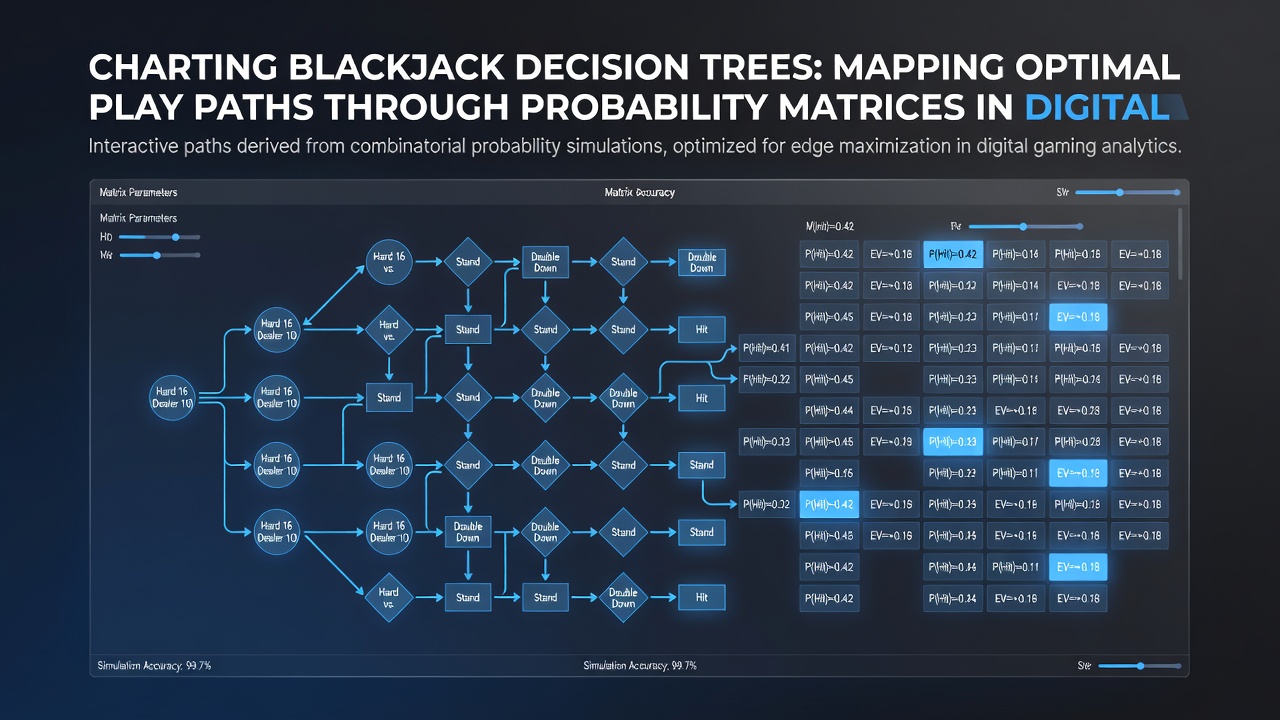
Software engineers frequently optimize tree traversal by pruning low-probability branches early, which shortens computation time without sacrificing accuracy because those branches contribute negligibly to overall expected value. One study published through the Journal of Gambling Studies revealed that pruned trees retain over 99 percent of original accuracy while reducing processing load by roughly 40 percent on standard hardware configurations.
Mapping Optimal Play Paths in Real Time
Real-time path mapping requires continuous recalculation of remaining deck probabilities after every card, and digital systems achieve this through incremental matrix updates rather than full recomputation from scratch. Those who have examined online implementations note that path highlighting changes color when matrix values shift across decision boundaries, giving players immediate visual cues about whether to deviate from a preloaded basic strategy chart. Regulatory testing in jurisdictions overseen by the Nevada Gaming Control Board confirms that certified systems produce identical recommendations to published basic strategy tables when decks remain full, validating the underlying matrix calculations.
Integration with Multiplayer and Tournament Formats
Multiplayer environments introduce shared shoe states across tables, so probability matrices must account for cards visible at adjacent positions that affect every participant's decision tree simultaneously. Tournament software layers additional constraints onto these matrices by incorporating payout structures and survival probabilities, creating hybrid trees that balance expected value against elimination risk. Figures released by European gaming research groups indicate that players who consult synchronized digital matrices during tournament play maintain higher survival rates through later rounds compared with those relying on memorized charts alone.
Conclusion
Digital decision trees and probability matrices together provide a precise framework for charting optimal blackjack paths, and ongoing refinements in software continue to narrow the gap between theoretical calculations and live-play execution. As platforms adopt more sophisticated synchronization methods, players gain access to constantly updated guidance that reflects exact remaining deck conditions. The integration of these tools into everyday digital formats marks a measurable shift in how strategy information reaches participants across regulated markets worldwide.