Mapping Blackjack's Rule Adaptations Through Regional Licensing Frameworks and Their Effects on Payout Distributions
Written by Alex Richter · Jul 27, 2026
Mapping Blackjack's Rule Adaptations Through Regional Licensing Frameworks and Their Effects on Payout Distributions
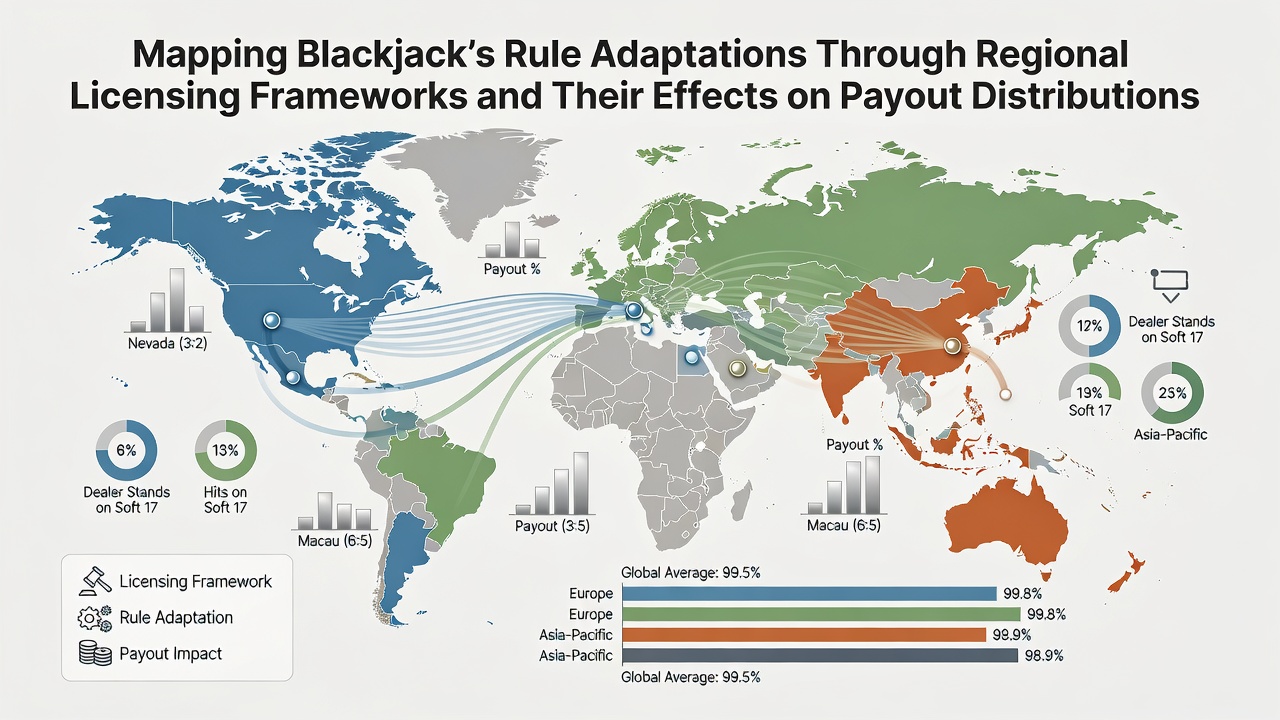
Blackjack rules shift according to licensing requirements set by different regulatory bodies, and these adjustments directly influence payout distributions through changes in house edge calculations. Licensing frameworks in places like Nevada, New Jersey, and various European markets require operators to adapt elements such as deck counts, dealer actions on soft seventeen, and doubling restrictions, which alters expected returns for players over time. Data from regulatory reports shows that a single rule change, like allowing double after split, can reduce the house edge by 0.14 percent in standard multi-deck games, while prohibitions on that same option increase it correspondingly.
Core Rule Elements Shaped by Licensing
Licensing authorities establish baseline parameters that operators must follow, and these parameters include the number of decks in play, which ranges from one to eight depending on the jurisdiction, along with whether the dealer hits or stands on soft seventeen. In jurisdictions using single-deck games the payout distribution favors players more when natural blackjacks pay 3 to 2, whereas six-deck or eight-deck setups common in larger markets shift probabilities toward the house unless offset by other player-friendly options like late surrender. Researchers at the University of Nevada, Las Vegas documented how these deck variations produce measurable differences in long-term return-to-player percentages across licensed venues.
Dealers in certain regions must stand on all seventeens while others hit soft hands, and this distinction alone accounts for house edge swings between 0.20 and 0.80 percent according to industry analyses. Licensing bodies also dictate resplit rules and whether doubling is permitted on any two cards or restricted to totals of nine through eleven, creating further layers of adaptation that operators implement to maintain compliance while managing payout structures.
Regional Examples and Their Payout Impacts
Nevada's framework permits wide variation across properties, which leads to games with payout distributions that range from 99.5 percent return to player in the most favorable configurations down to 98.2 percent in stricter setups. New Jersey's Division of Gaming Enforcement enforces tighter standardization on multi-deck games, resulting in consistent house edges around 0.40 percent when combined with mandatory shuffling procedures and electronic verification systems. Australian state regulators apply different constraints on progressive side bets and rule flexibility, which data from 2025 reports indicates produces slightly higher average house edges compared to North American markets due to restrictions on early surrender.
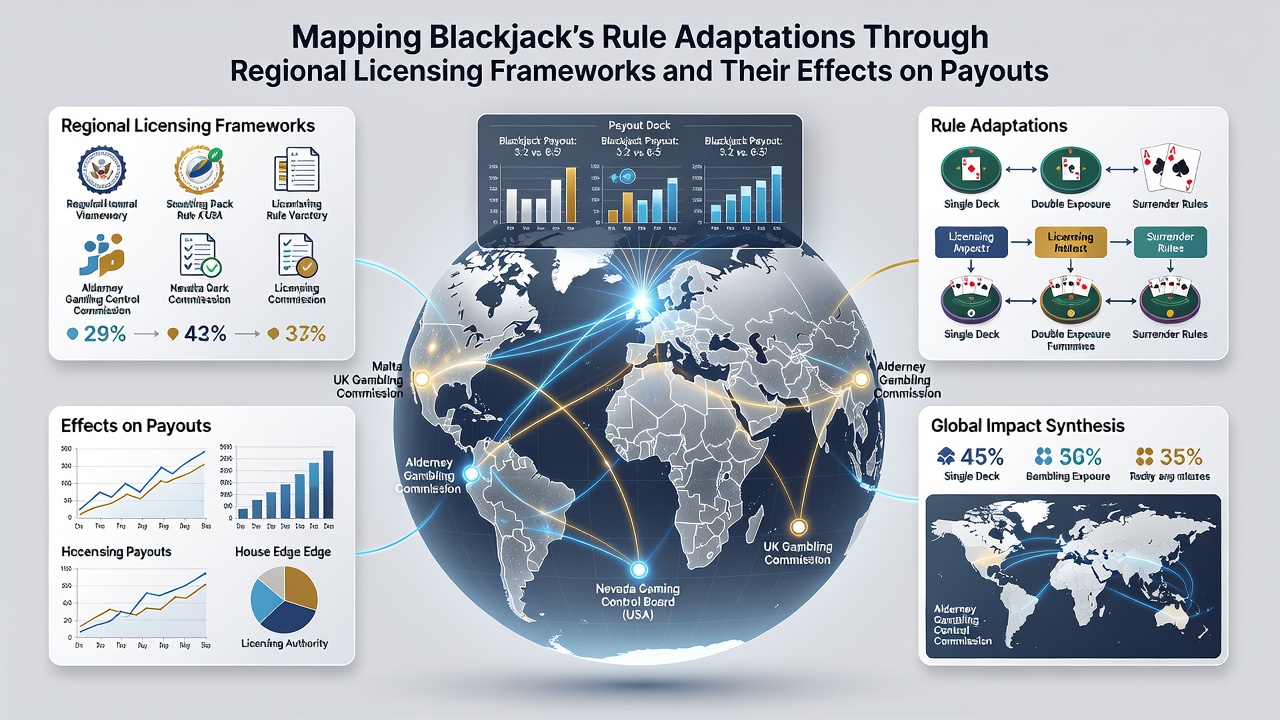
European markets under frameworks like those overseen by the Malta Gaming Authority allow continuous shuffling machines in many cases, and this technology interacts with licensing rules on deck penetration to produce payout distributions that favor quicker rounds with marginally higher house edges. In contrast, Canadian provincial licenses often emphasize player options such as double after split across all pairs, which studies show improves return-to-player figures by measurable margins when all other rules remain constant. Observers note that operators adjust table minimums and maximums in response to these regulatory demands to balance volume against per-hand payout volatility.
Data Patterns Across Jurisdictions in 2026
As of July 2026 licensing updates in several North American and Asian markets have introduced new requirements for real-time reporting of rule configurations, and these changes allow regulators to track how adaptations affect aggregate payout distributions more precisely than before. Figures from the Nevada Gaming Control Board reveal that properties offering 3-to-2 blackjack payouts alongside dealer-stand rules maintain higher player retention rates even when overall house edges stay within narrow bands. Academic papers published through gaming research centers demonstrate that regional differences in insurance availability and even-money options further compound these effects, producing distinct payout curves that operators must model during license renewal processes.
Patterns emerge when comparing multi-jurisdiction operators who standardize rules where possible yet still encounter mandatory local variations that alter expected returns. One analysis of payout data across licensed sites found that games permitting resplitting up to four hands reduced house edges by an additional 0.03 to 0.05 percent compared to single resplit limits, illustrating how seemingly minor licensing stipulations accumulate into noticeable distribution shifts over thousands of hands.
Conclusion
Regional licensing frameworks continue to drive adaptations in blackjack rules that reshape payout distributions through precise adjustments to house edge factors. Regulatory data from multiple jurisdictions confirms that elements such as deck quantity, dealer hitting rules, and doubling permissions create measurable differences in long-term returns, and operators must navigate these requirements while maintaining compliance across markets. Ongoing updates in 2026 highlight the dynamic nature of these interactions as authorities refine reporting standards and operators respond with corresponding table configurations.