Unpacking the Algorithms Behind Progressive Jackpot Triggers in Multi-Player Digital Card Environments
Written by Kai Hughes · Jul 13, 2026

Unpacking the Algorithms Behind Progressive Jackpot Triggers in Multi-Player Digital Card Environments
Progressive jackpot systems in multiplayer digital card environments rely on interconnected algorithms that pool contributions from simultaneous player bets across distributed tables and then determine payout moments through specific trigger mechanisms. These setups appear in online poker rooms, shared blackjack lobbies, and hybrid card titles where multiple participants feed a common prize meter in real time.
Core Contribution Mechanics
Each wager placed at participating tables routes a fixed percentage, often between one and five percent, into the growing jackpot pool while the remainder returns to the house or funds regular payouts. Software layers track these micro-transfers across regions and time zones, updating the visible meter for every connected player within milliseconds. Network synchronization protocols ensure that no single table operates in isolation, so bets from one jurisdiction immediately influence the shared total visible elsewhere.
Random Number Generation and Trigger Logic
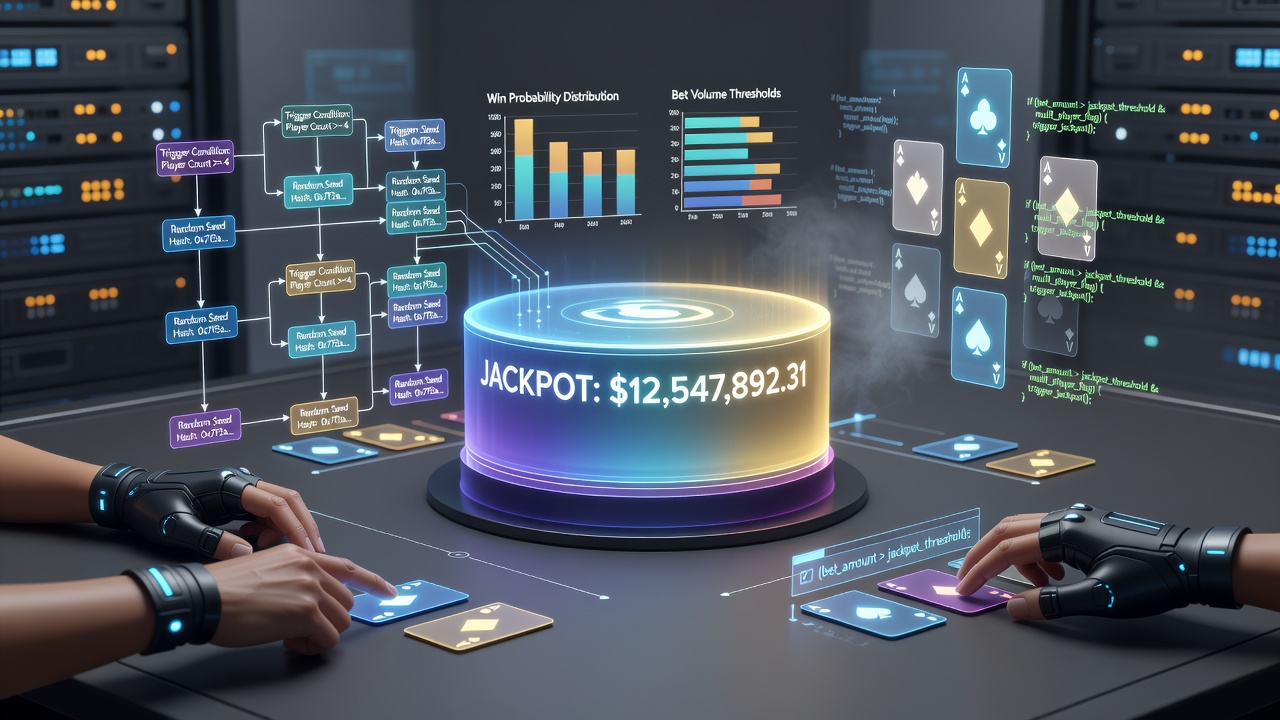
Jackpot activation hinges on pseudorandom number generators certified by independent testing labs. The algorithm continuously samples values against a pre-set threshold that corresponds to the current pool size, creating a probability curve that rises as contributions accumulate. In mystery jackpot variants the trigger remains hidden from players, whereas must-hit-by implementations publish an upper limit that forces a payout once the meter reaches that ceiling. Both approaches run on teh same underlying RNG framework, yet they differ in how the threshold calculation incorporates historical contribution rates and player volume forecasts.
Multiplayer Network Considerations
Shared environments introduce additional variables because hundreds of concurrent sessions must feed the same pool without introducing latency or desynchronization. Load-balancing servers segment traffic by geography while maintaining a single authoritative jackpot ledger, and failover mechanisms replicate pool data across multiple data centers to prevent loss during outages. Observers note that these architectures became more robust after 2024 upgrades that introduced blockchain-style checksums for every contribution transaction, allowing auditors to verify integrity without exposing individual bet details.
Certification and Regulatory Oversight
Independent laboratories evaluate the RNG sequences and contribution formulas against published standards before platforms receive operational approval. Data from the Nevada Gaming Control Board indicates that progressive systems undergo quarterly statistical reviews to confirm that payout frequencies align with advertised probabilities. Similar evaluations occur under the Malta Gaming Authority framework, which requires source code escrow and periodic re-testing whenever pool parameters change. As of July 2026 several platforms completed integration of enhanced entropy sources drawn from quantum random number generators, further reducing predictability concerns raised in earlier academic analyses.
Recent Implementation Patterns
One study released by researchers at the University of Nevada, Las Vegas examined contribution scaling across peak traffic hours and found that pool growth accelerates nonlinearly once concurrent player counts exceed 500. This pattern influences how operators adjust the percentage skimmed from each bet to maintain target payout intervals. Another case involved a European operator that recalibrated its mystery trigger after observing that certain card variants produced faster pool growth than others, prompting a shift from fixed-percentage models to dynamic contribution rates based on real-time game velocity.
Security Layers Around the Algorithms
Encryption protects both the RNG seed values and the live jackpot ledger during transmission between game servers and the central pool manager. Multi-factor authentication restricts access to configuration files that define trigger thresholds, while intrusion detection systems monitor for anomalous query patterns that might indicate attempts to manipulate payout timing. Regular penetration testing by third-party firms verifies that these controls remain effective against evolving attack vectors documented in industry threat reports.
Conclusion
Algorithms governing progressive jackpots in multiplayer digital card environments combine contribution tracking, certified random number generation, and synchronized network protocols to deliver shared prize opportunities. Regulatory bodies across multiple jurisdictions continue to refine testing requirements, and platform operators respond with incremental technical upgrades that maintain fairness while supporting growing player volumes. These systems remain central to the operational architecture of contemporary online card platforms.